How to Excavate the Foundation Trench for an Indoor Artificial Turf Field
How to Lay and Compact Gravel
Indoor artificial turf fields, covered with PVC, are built to be very durable and are unaffected by heavy snow and rain in winter or by sun rays in summer. As they do not let cold and hot air in, they can be used comfortably in all seasons. During construction, the concrete foundation of the applied artificial turf field is first started. For this, a foundation trench is excavated in the existing area, and the soil removed during excavation is cleared from the area. The excavation should be done such that the 30 cm part of the foundation concrete remains above ground. Stirrups are formed with 8 mm construction iron at 20 cm intervals. Then, the corners are connected using 12 mm diameter construction iron and 4 beams. Anchor sockets are placed in the foundation molds measuring 25 cm and 60 cm, and the prepared mold is made ready for reinforced concrete using vibration. After the foundation concrete is completed during the construction of the indoor artificial turf field, the 20 cm part above the foundation is filled with gravel. After being spread on the ground of the sports area, it is pressed and compacted.
Installing Vertical Pipes and Netting
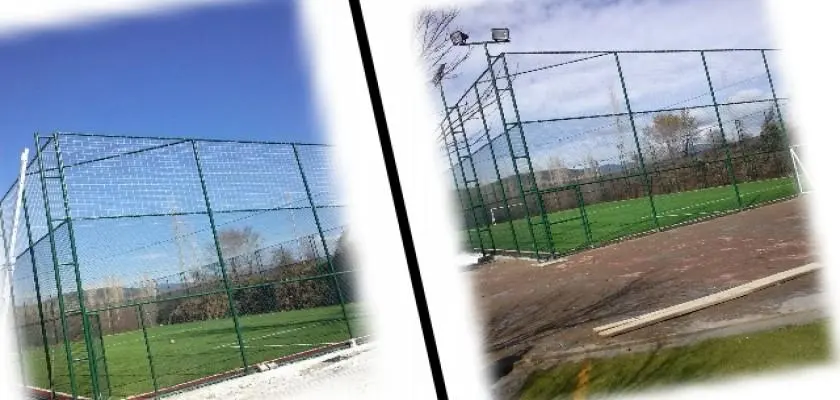
Pipes of 76 mm with a 7 mm section remaining above are placed inside the foundation mold. The vertically positioned pipes are connected to each other by welding at their lower, middle, and upper parts. 4 lighting structures are placed on the long sides of the field. After the entrance gate is added to the artificial turf field, goalposts and goal nets suitable for the field are also made. After the construction is completed, it is painted with industrial green paint. During the construction of the indoor artificial turf field, galvanized steel ropes are stretched in four rows and placed on the back and sides of the goal to cover the surroundings with wire fences. Then, steel ropes are stretched across the entire field to prevent the ball from going out of bounds. The sides and back of the goal are covered with double-layered PVC-coated galvanized mesh wire. Cabling and grounding are done for the lighting systems placed at a considerable height to function. The cables of Olympic-type projectors with a power of 400 watts, 8 on the right and 8 on the left, totaling 16, are connected and mounted.